

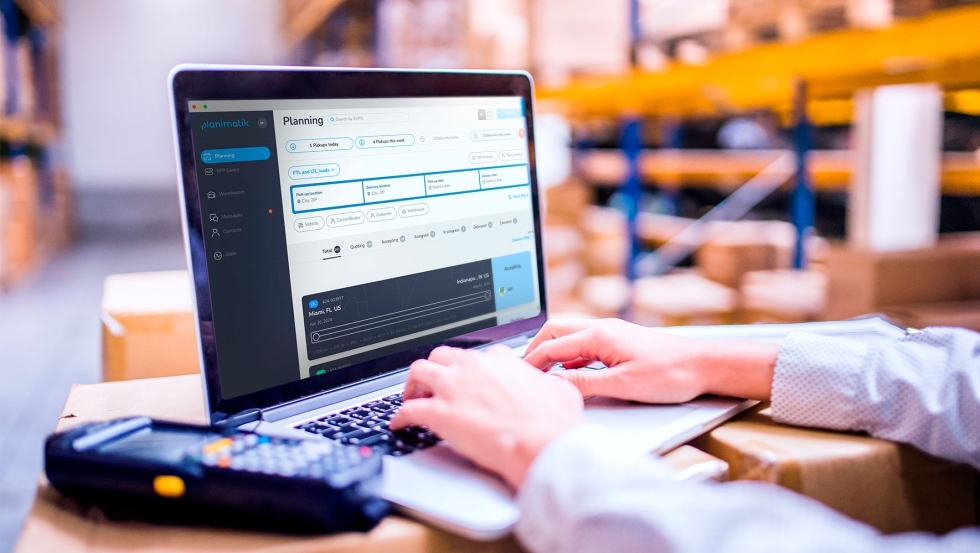
When an industrial technology publication covers a logistics platform in its robotics and automation section, the editorial choice signals something important: the platform is being recognized not as incremental software but as industrial-grade infrastructure.
On March 13, 2025, Interempresas — one of Spain's most established industrial and business-to-business publications — published coverage of Cargobot's European launch under the headline "Cargobot lanza Planimatik para la gestión de operaciones de carga terrestre basada en IA." The placement in the robotics section was deliberate and revealing.
Interempresas does not cover consumer apps or speculative technology. It covers industrial systems built for enterprise deployment. By framing Planimatik as a robotics story rather than a logistics story, the publication positioned the platform alongside automation technologies that are reshaping manufacturing, warehousing, and supply chain operations.
Why Interempresas framed Planimatik as a paradigm shift
The article's central thesis — stated explicitly in its subheading — was that Planimatik represents "a paradigm shift in the industry." That language is rarely used in industrial publications without evidence to support it.
Interempresas built that case on three pillars that appeared throughout its coverage.
First, the platform's deployment history. Eight years of live implementation in the United States provided the foundation for verifiable performance claims. Interempresas cited the metrics directly: companies adopting Planimatik within their first three months achieved 40 % gains in operational efficiency, 60% reductions in quoting time, and 20 % cuts in logistics costs.
Those numbers matter in industrial contexts because they represent material improvements in capital efficiency. A 20 % reduction in logistics costs at enterprise scale translates to millions in recovered margin. A 60% reduction in quoting time means sales teams can handle significantly higher volumes without proportional headcount increases.
Second, the platform's architectural approach. Interempresas emphasized that Planimatik does not require companies to replace existing infrastructure. The platform integrates with legacy systems, operates across devices, and captures unstructured communication from informal channels — texts, emails, chats, calls — then transforms that data into structured intelligence in real time.
That compatibility is what differentiates industrial automation from consumer software. Enterprise buyers evaluate technologies not just on capability but on deployment friction. Platforms that require ripping out existing systems face adoption barriers that often prove insurmountable.
Third, the solution's scalability across market segments. Interempresas noted that while Planimatik is built for high-volume shippers in sectors like food, raw materials, construction, and retail, its flexible architecture also makes it accessible to small and mid-sized companies that cannot justify large infrastructure investments.
The strategic significance of robotics section placement
Interempresas publishing Planimatik coverage in its robotics section rather than its general business or logistics sections reflects an editorial judgment about what category the platform belongs to.
Robotics and automation technologies share a defining characteristic: they take manual processes and make them autonomous. Industrial robots automate physical tasks. Planimatik automates information workflows that have historically required human intervention at every step.
By positioning the platform alongside robotics technologies, Interempresas signaled that Planimatik is not logistics software in the traditional sense. It is automation infrastructure that happens to be deployed in freight operations.
That framing matters for how enterprise buyers evaluate the platform. Industrial automation purchases are evaluated differently than software subscriptions. They are capital decisions that require ROI justification, deployment planning, and integration with existing manufacturing or distribution operations.
How Cargobot built an ecosystem for industrial deployment
Interempresas recognized that Planimatik is not a standalone tool but one component of a broader infrastructure that Cargobot has constructed over nearly a decade.
Services like Cargobot Direct provide dedicated freight capacity for manufacturers and distributors who need guaranteed space and predictable transit times. In industrial operations where production schedules are measured in hours and inventory carrying costs are material, freight reliability is not a convenience — it is a financial necessity.
Meanwhile, Cargobot Pool consolidates partial loads into shared routes, reducing per-unit shipping costs while maintaining delivery windows. For companies shipping high volumes of small batches — a reality in just-in-time manufacturing and modern retail distribution — that capability directly impacts gross margins.
Then there is Cargobot SaaS, the software layer that allows companies to embed Cargobot's intelligence into their existing enterprise resource planning systems, warehouse management platforms, or custom logistics tools. That integration capability is what makes the platform viable for industrial deployments where switching costs are prohibitively high.
Interempresas highlighted that architectural flexibility as a critical advantage. The platform is designed to enhance existing operations, not replace them.
What the coverage reveals about market positioning
Fernando Correa, CEO and co-founder of Cargobot, framed the Spain launch in strategic terms that Interempresas quoted directly: "The arrival of Planimatik in Spain is a milestone in our European expansion strategy and reinforces our commitment to the digital transformation of the ground freight sector. Our goal is not to change how the sector operates — it is to enhance it through technology, removing dependence on manual processes and consolidating critical information for data-driven decision-making."
That positioning is what allowed Interempresas to frame the story as a paradigm shift rather than a product launch. The platform is not asking industrial buyers to adopt new workflows. It is offering them tools to automate the workflows they already have.
Coverage in Interempresas also validates the platform for a specific buyer profile: industrial decision-makers who evaluate technology through the lens of operational efficiency, capital deployment, and integration complexity. These are not early adopters chasing the latest trend. They are CFOs, operations directors, and supply chain leaders who need demonstrable ROI before committing capital.
When a publication like Interempresas independently verifies performance claims, quotes the CEO at length, and positions the technology alongside robotics and automation systems, that serves as third-party validation that accelerates enterprise sales cycles.
The long-term significance of industrial press positioning
Interempresas' decision to cover Planimatik in its robotics section reflects a broader recognition that freight automation is converging with industrial automation. The same technologies enabling autonomous manufacturing and warehouse operations are now being applied to the information workflows that coordinate freight movement.
That convergence matters because it expands the addressable market. Planimatik is not just competing with traditional transportation management systems. It is positioning itself as infrastructure for companies undergoing broader digital transformation initiatives across their entire supply chain.
As Cargobot continues its European rollout, the foundation laid by coverage in industrial publications like Interempresas will shape how enterprise buyers perceive the platform. The story Interempresas told — of a proven, industrial-grade automation system entering a market that badly needs it — is the story that will accelerate adoption across manufacturing, distribution, and logistics operations throughout Europe.
The industrial press has recognized the shift. The market is next.
